Listen to Dr Paul Doornbusch talk on the process of reconstructing the music of CSIRAC and his journey into the history of computer music in Australia.
Introduction
The Australian-built automatic computer, initially known as the CSIR Mk1 and later known as CSIRAC, was one of the world’s earliest stored program electronic digital computers. Developed in Sydney in the late 1940s by the Council for Scientific and Industrial Research (CSIR), the CSIR Mk1 ran its first program in November 1949. Trevor Pearcey, an English radio physicist, and Maston Beard, a researcher at the CSIR Radiophysics Laboratory in Sydney designed the CSIR Mk1.
The first ‘programmer’ or real software engineer to work with the CSIR Mk1 was Geoff Hill, a mathematician who assisted with the logical design. Hill, who came from a musical family, programmed the CSIR Mk1 to play popular musical melodies from the very early 1950s. In 1951 the CSIR Mk1 publicly played the tune Colonel Bogey. The CSIR Mk1 was moved to Melbourne in June 1955 and renamed CSIRAC.
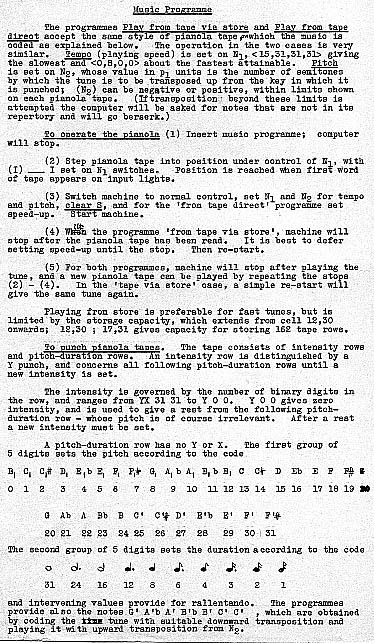
In Melbourne, the mathematics professor Thomas Cherry programmed CSIRAC to perform music and developed a system and program such that anyone who understood standard musical notation could create a punched paper data tape for CSIRAC to perform that music.
The music performed by the CSIR Mk1 may seem crude and unremarkable compared to the most advanced musical developments of the time and with what is possible now, but it is amongst the first computer music in the world and the means of production was at the leading edge of technological sophistication at the time. These first steps of using a computer in a musical sense occurred in isolation and they are interesting because it is the leap of imagination to use the flexibility of a general computer to create music and the programming ingenuity required to achieve that which is significant. CSIRAC took some initial steps in that direction.
CSIRAC and sound production
For a full overview regarding the operation of CSIRAC please see CISRAC: Our first Computer.
The sounds produced by CSIRAC were shaped by the machine's architecture.
CSIRAC was a serial computer with mercury acoustic delay-line memory. To understand something of the operation of CSIRAC, it is important to appreciate that all operations were considered as serial transfers of numbers, or data, from a ‘source’ to a ‘destination’.
A source could be a register, a memory location, the accumulator and so on. A destination could be a memory location, a register, the paper tape punch or the speaker and so on.
During the transfer, the data could undergo transformation, such as being subtracted. The instruction set partitioned each digital word into a ‘destination’, a ‘source’ and a data address. The data address, if it applied to the main (mercury delay line) memory, determined the position, or time, of the data in the delay line.
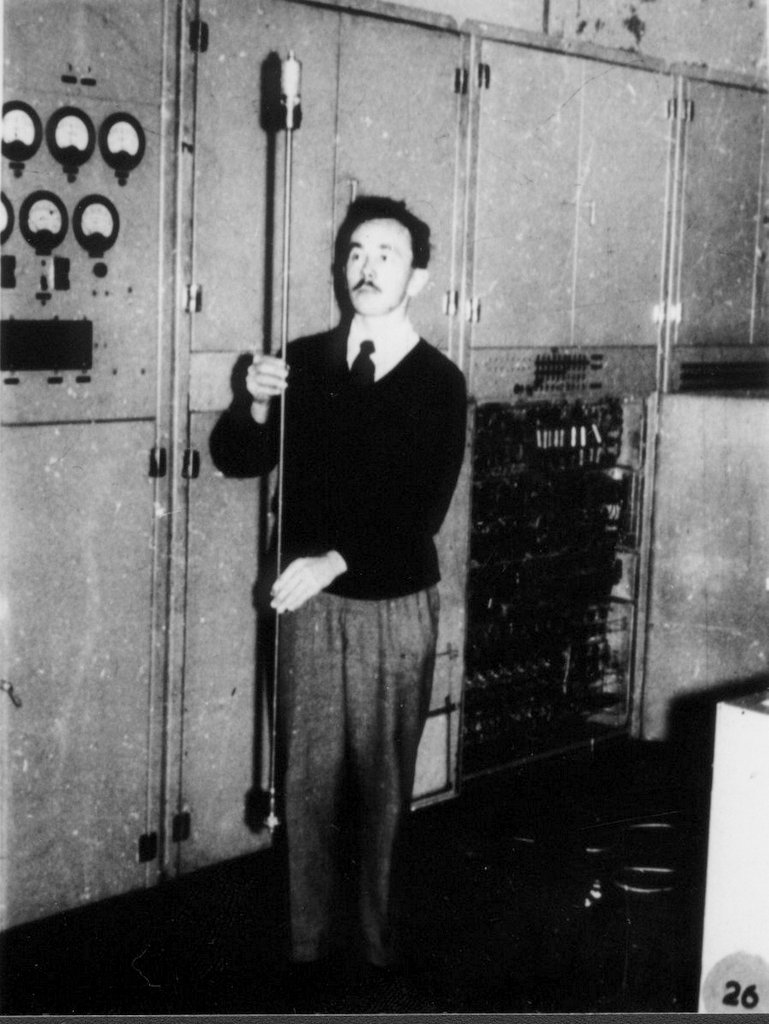
Because the memory was a recirculating delay line and the whole machine architecture was serial, it was required to wait until a particular memory location was available for reading. The memory space was very limited at 768 words in total.
Understanding the machine timing issues is the key to understanding how the music was produced. Each memory tube was a delay line, so the data in each position in a memory tube required a different time to access. It was possible to calculate this time and determine how long after the start of a clock or access cycle the data was read.
Numbers were placed in specific memory locations in such a way that when they were read out and sent to the speaker, they were pulses with a pre-determined period. In this way a predictable pitch was produced and used to create musical melodies.
Electronic music and technology at the time of CSIRAC
There was significant activity in electronic music before the development of the CSIR Mk1 and before the more experimental and adventurous musical developments after World War II.
- In the late 1890s Thaddeus Cahill created the first major electronic instrument, the ‘Telharmonium’.
- In 1920 Moscow, Leon Theremin developed an instrument that was played by the performer moving his hands near two antennae.
- Throughout the 1920’s and 1930’s, many other electric and electronic instruments were developed such as the ‘sphärophon’, the ‘Dynaphone’, the ‘Ondes Martenot’ and the ‘Trautonium’.
CSIRAC had a similarity to most of these instruments in that it was also used to play traditional instrumental music, and like many other instruments, it could do more.
In parallel there were other developments that used electronics and took a fresh and less musically restrictive approach to both sounds and music itself. Percy Grainger, after writing ‘Free Music’ for theremins and because of his interest in free music, developed his own electronic musical instruments with the assistance of Burnett Cross. Similarly, Huge Le Cain’s ‘Coded Music Apparatus’ also allowed control of sound synthesis by visual curves.
Most early electronic musical instruments were used to play electronic renditions of standard repertoire and not to create new music.
The real history and legacy of electronic music comes from developments which happened at about the same time that CSIRAC was being planned and built.
Against the background of the great artistic expansion, the spirit of freedom, reconstruction and liberation artists felt after World War II, electronic music blossomed. There were two significant emerging developments:
- ‘Musique concrète’, where music is created with recorded sounds, was establishing itself in the late 1940s through the activities of Pierre Schaeffer and Pierre Henry.
- Analog electronic music was the other area of intense interest where, as distinct from musique concrète, sounds are generated purely by electronic means, using oscillators, filters and so on. Some of the main composers who pioneered this work are Gottfried Michael Koenig, Karlheinze Stockhausen, Karel Goeyvaerts, and Herbert Eimert. Such musical developments were dependent on the available technology of electronic oscillators, filters and tape recorders.
In addition, at the time CSIRAC was being designed and built, John Cage, Pierre Boulez and others were writing advanced instrumental music, developing new composition theories and becoming interested in electronic music. Against this background, but in isolation, CSIRAC first played music.
While the musical output of CSIRAC was unimaginative compared to many of the musical developments emerging during its early years, there was considerable imagination required to use a general computing machine to play music and there was a great deal of ingenuity required to devise the techniques and programs to play it.
From a computing perspective, it is not simple to put activities into historical context. There is a problem of definition - what combination of hardware and software capabilities constitutes a computer? Charles Babbage created some early mechanical calculators. Konrad Zuse created some early electromechanical calculators and his Z3 of 1941 has been called the first electromechanical programmable calculator.
Alan Turing’s ‘Colossus’ was operational in 1943 and it has been called the first all-electronic programmable calculator as it had no memory and was driven by a punched paper tape. ENIAC was designed as a calculator but was later given programmable control. Eckert’s SSEC, in 1948, was a configurable calculator which could execute programmed instructions. This list could continue and fill several volumes. (There are some internet references here.)
However, if one accepts the general definition of a digital computer as an all-electronic device capable of calculating and branching operations, where the data and instructions are held in some sort of rewritable memory, then the following series of events is an approximate guide to when the first all-electronic digital computers ran their first test programs.
- June 1948
-
MADM first run, Manchester University UK
- May 1949
-
EDSAC first run, Cambridge University UK
- August 1949
-
BINAC first run, Eletronic Control Co. USA
- September 1949
-
Harvard Mark III first run, Harvard University USA
- November 1949
-
CSIR Mk1 first run, CSIR Radiophysics Australia
- May 1950
-
ACE, UK and SEAC, USA
CSIRAC's loudspeaker
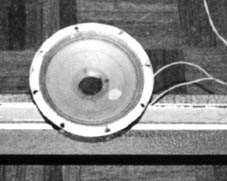
Like most first generation computers, the CSIR Mk1 had a built-in speaker, a Rola 5C mounted on the console frame. The speaker, or ‘hooter’ as it was known, was an output device used by programmers to signal that a particular event had been reached in the program. It was commonly used for warnings, often to signify the end of the program and sometimes as a debugging aid.
The speaker on the CSIR Mk1 was built into the computer in such a way that it was a destination for data, effectively on a register of the machine and it received the raw pulse data off the ‘bus’.
A single pulse would barely make a click and it required much more effort on the part of the program to get a predictable sound. Multiple pulses (as a short loop of instructions) were required to achieve an audible result. The timing of this loop of instructions caused a change in the frequency of the sound from the hooter. Any programmer with an interest in sound or music would immediately see the potential available.
Although the musical developments with the CSIR Mk1 were accomplished in isolation and with no precedence, it was not unique at that time. The Ferranti Mark I had a hooter arrangement very similar to that on the CSIR Mk1 and it was used to play music in 1951. The music played by the Ferranti Mark I was recorded by the BBC in September 1951.
The recording in the British National Sound Archives was restored by Turing Archive for the History of Computing in 2018 through a process of pitch adjustment and computer-assisted frequency analysis.
Music played by CSIRAC
Music in Sydney
The first programmers of the CSIR Mk1 were Geoff Hill and Trevor Pearcey. Geoff Hill had perfect pitch and came from a very musical family. Hill was the first person to program the CSIR Mk1 to play a musical melody. It was played publicly for the first public exhibition of the computer on the 7th to 9th of August in 1951, at the inaugural Conference of Automatic Computing Machines in Sydney.
The sound production technique used on the CSIR Mk1 was as crude as is possible to imagine on a computer. Raw pulses of the computer’s data words were sent to an audio amplifier with a speaker attached. However, this occurred when there were no digital-to-analog converters, there was no digital audio practice and little in the way of complete digital audio theories. In addition, the CSIR Mk1 produced music in real-time.
The musical pieces played by the CSIR Mk1 are not as musically inspiring as they might have been if composers had been involved in creating the music. The computer had a lot to offer composers of the time, any frequency and any rhythm could have been programmed so the many composers interested in microtonal works, or music with no rhythm or very complex rhythms, could have created some very interesting music. Now, the music is most interesting from the point of view of the application of computers to music as a general principle and for the early practice of computer programming to create music.
The achievement is significant because of the imagination of the practitioners, to conceive of using the flexibility of a digital computer to make music and because of the ingenuity required to devise means to produce reliable sounds from the computer. It is difficult to appreciate now just how skillful these people were.
It is significant that it was only two of the best programmers who managed to program the CSIR Mk1 to play music.
The CSIR Mk1 operated in Sydney Australia from about November 1949 to June 1955. Geoff Hill was the main programmer at that time and he used the machine to play musical melodies. These melodies, mostly from popular songs, were; ‘Colonel Bogey’, ‘Bonnie Banks’, ‘Girl with Flaxen Hair’ and so on.
Music in Melbourne
The CSIR Mk1 was dismantled in mid-1955 and moved to The University of Melbourne, where it was renamed CSIRAC. Professor of Mathematics, Thomas Cherry, later Sir Thomas Cherry FRS, had a great interest in programming and music and he created music with CSIRAC.
In Melbourne the practice of how CSIRAC was programmed for music was altered and refined somewhat. The program tapes for a couple of test scales still exist, along with the popular melodies ‘so early in the Morning’ and ‘In Cellar Cool’, which was a popular drinking song — it appears that the pursuit of computer music and social drinking have been intimately linked since the earliest years. There was also other music on the tape.
Around 1957, Cherry wrote a music performance program that would allow a computer user who understood simple standard music notation to enter it easily into CSIRAC for performance, without negotiating all of the timing problems such as was normally required. The music itself may now seem very crude unless it is understood in the context of its creation. It was created by engineers who were not knowledgeable of the latest in musical composition practice and at a time when there was little thought of digital sound.
The idea of using a computer, the world’s most flexible machine, to create music was a leap of imagination at the time. It is a pity that composers were not invited to use CSIRAC, as they were with the Bell Labs developments, to discover how it could have solved several compositional problems.
Cherry’s instructions for the Music Programme. N1, N2 and I are registers that are set with console switches.
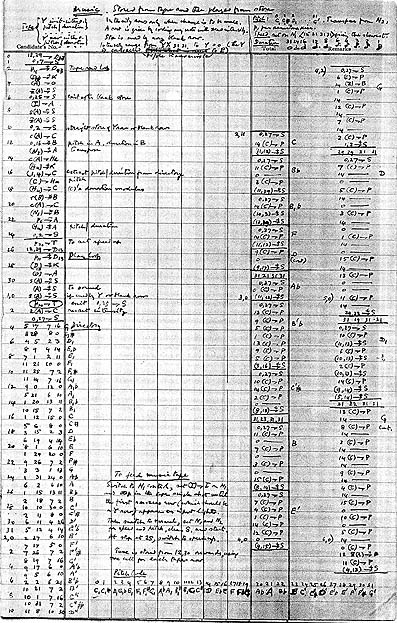
Part of the program is on the left and the note data is on the right hand side of the page. The list of notes at the bottom (Pitch Code) is correct, but in the previous instructions for the program they are transposed
Contemporary accounts in the press
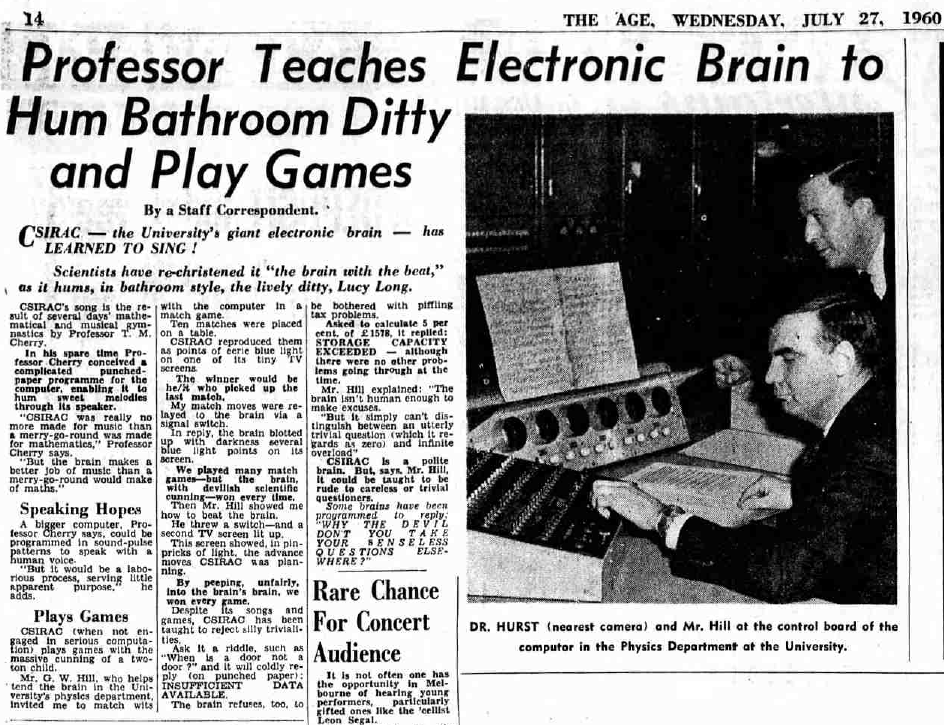
CSIRAC made news headlines for its musical abilities. Below are extracts from two articles that mention the music.
From The Melbourne Age , Wednesday 27th July 1960:
CSIRAC — the University’s giant electronic brain — has LEARNED TO SING!
…it hums, in bathroom style, the lively ditty, Lucy Long. CSIRAC’s song is the result of several days’ mathematical and musical gymnastics by Professor T. M. Cherry. In his spare time Professor Cherry conceived a complicated punched-paper programme for the computer, enabling it to hum sweet melodies through its speaker… A bigger computer, Professor Cherry says, could be programmed in sound-pulse patterns to speak with a human voice…
From The Melbourne Herald , Friday 15th June 1956:
…When CSIRAC began sporting its musical gifts, we jumped on his first intellectual flaw. When he played “Gaudeamus Igitur,” the university anthem, it sounded like a refrigerator defrosting in tune. But then, as Professor Cherry said yesterday, “This machine plays better music than a Wurlitzer can calculate a mathematical problem” …
Reconstruction of the music played by CSIRAC
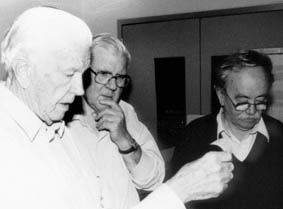
The music played by CSIRAC was never recorded onto any audio storage format. Little was known about the music, but several people who had heard from 1951 to the mid-1960s were still around to tell of it even though it could not be heard any more. A plan was developed to reconstruct the music. Three essential people who would be needed for this endeavour, Ron Bowles, John Spencer and Jurij (George) Semkiw, were currently involved with a project at the University of Melbourne to document CSIRAC
. John Spencer was a programmer on CSIRAC who remains highly skilled with CSIRAC programs and he has also written a comprehensive emulator for CSIRAC. Ron Bowles and George Semkiw were CSIRAC maintenance engineers who have intimate experience and undocumented knowledge of the internal workings of the machine.
The music was to be reconstructed as exactly as possible, to within an accuracy of better than one percent of the waveforms that would have been heard at the time the pieces were originally played. The pulse shapes, as reproduced, are well within one percent accuracy of the CSIRAC pulse shape, but the pulse timing is at least 10 times more accurate than that. This waveform accuracy would ensure a listening experience faithful to the original and would also ensure that any technical analysis of the waveform would be valid.
The best reconstruction of the music was achieved by separating the reconstruction of the timing of the pulses from the reconstruction of the pulse shapes. The course of action taken was; read the program and data tapes (and get them working, a non-trivial matter), use several programs John Spencer developed from his emulator to generate the speaker pulse timing data, build hardware (some with valve technology) to reproduce the pulse shapes that appeared at the speaker terminals, combine these to reproduce the pulse stream. This pulse stream could then be played through the original speaker and recorded.
Listen
Audio reconstruction of CSIRAC playing Colonel Bogey (c.1951)
CSIRAC plays In Cellar Cool with a simulation of CSIRAC’s room noises.
Acknowledgements, sources and links
Many people have helped with the recreation and publication of this work and have provided encouragement to me throughout this project. It has been a pleasure to be involved with some of the original pioneers of computing in Australia. I hope that I have made clear the roles played by the people who worked with CSIRAC. I would like to thank all of them and the interviewees for their generous time and assistance. The interviewees are; Reginald Ryan, Terry Holden, Kay Thorne, Peter Thorne, Ron Bowles, Eileen Hill, Douglas McCann and Dick McGee. I am particularly grateful to; Ron Bowles, Jurij Semkiw, and especially John Spencer, for their gracious patience with my naive questions, their generosity and their skills, without which this project could never have progressed beyond the imagination stage — many thanks.
The University of Melbourne, Department of Computer Science and Software Engineering has been extremely helpful and supportive, providing access to people and facilities. Thanks are due especially to Peter Thorne and Leon Sterling for this.
Thanks to Museum Victoria, especially Catherine Lovelock, Fiona Kinsey and David Demant who allowed me unfettered access to CSIRAC, now a prized museum object, to achieve the most faithful recreation possible of the music.
I am very grateful to the many other people who have helped 'behind the scenes', providing their time, encouragement, expertise and sometimes equipment. These people are: John Crawford, Doug McCann, Judith Hughes, Warren Burt, Steven Pass and the Technical Services staff including John Horvath and Andrew Peel.
Thanks to The Pearcey Foundation for assistance in the early stages of this project.
Chris Burton very kindly provided unique information about early British computers through private correspondence and connection with the Computer Conservation Society.
Thanks to Gus Gollings who was tireless and instrumental in the publication of the work, and to Sarah Kenderdine whose inspired ideas helped tremendously to bring this work to its published fruition.

Special thanks to Paul Berg for many years of inspirational mentor-ship and for reviewing this project.
This project was very generously assisted and funded by the Australian Commonwealth Government through the Australia Council, its arts funding and advisory body.
— Paul Doornbusch.
Sources
Much of the anecdotal and oral material was gathered over long periods of casual and personal contact with the people involved. For example, there were several pieces of the puzzle that came out during the CSIRAC 50th birthday celebrations in November 1999 and there were regular meetings on a Tuesday with John Spencer, Jurij Semkiw, Ron Bowles, Peter Thorne, Doug McCann and others.
Interview with Trevor Pearcey, recorded on 1st October 1996, interview conducted by Steven Pass, Doug McCann and Peter Thorne.
Interview with Reginald Ryan, conducted by the author, 25th January 2000.
Interview with Terry Holden, recorded 7th June 1997 by Steven Pass.
Interview with Kay Thorne, conducted by the author, 21st February 2000.
Interview with Peter Thorne, conducted by the author, 16th February 2000.
Interview with Ron Bowles, conducted by the author, 25th February 2000.
Interview with Eileen Hill, conducted by the author, 2nd March 2000.
Interview with Douglas McCann, conducted by the author, 15th May 2000.
Interview with Dick McGee, conducted by the author, 20th May 2000.
Private correspondence with Chris P. Burton, Computer Conservation Society.
Bird, J. 1999. “Percy Grainger” Sydney, Australia: Currency Press.
Cage, J. 1967. “Silence” Cambridge, Massachusetts, USA: The MIT Press
Chadabe, J. 1997. “Electric Sound the Past and Promise of Electronic Music” New Jersey, USA: Prentice-Hall, Inc.
CSIRAC Archive, The University of Melbourne Computer Science Department.
Dean, J. 1997. “CSIRAC Australia’s First Computer” Killara, New South Wales, Australia: Australian Computer Museum Society.
Hiller, L. A. and Isaacson, L. M. 1959. “Experimental Music" New York, USA: McGraw-Hill Book Company, Inc.
Manning, P. 1993. “Electronic and Computer Music” Oxford, England: Oxford University Press.
McCann, D. and Thorne, P. 2000. “The Last of the First: CSIRAC: Australia’s First Computer” Melbourne, Victoria, Australia: Melbourne University Computer Science.
Pierce, J. 1995. “Recollections by John Pierce” Part of “The Historical CD of Digital Sound Synthesis. Computer Music Currents 13” Mainz, Germany: Schott Wergo Music Media GmbH.
Roads, C. 1980. “Interview with Max Matthews “Computer Music Journal 4(4). Reprinted in C. Roads, ed. 1989. “The Music Machine” Cambridge, Massachusetts, USA: The MIT Press
Roads, C. 1996. “The Computer Music Tutorial” Cambridge, Massachusetts, USA: The MIT Press
Williams, M. R. 1997. “A History of Computing Technology" California, USA: IEEE Computer Society Press.