In 1947, Maston Beard and Trevor Pearcey led a research group at the Sydney-based Radiophysics Laboratory of the Council for Scientific and Industrial Research (now known as CSIRO), to design and build an electronic computer.
The resources they had available included the vacuum tube or “valve” technology and the pulse techniques developed for radar systems during World War II. Their developments parallelled, but were to a considerable extent independent of computer developments in Europe and the USA.
The CSIR Mk1 ran its first test programs in late 1949, and it was the fifth electronic stored program computer ever developed. It embodied many features novel at the time and was able to operate more than 1000 times faster than the best mechanical calculators. The machine was officially opened in 1951 and used to solve problems both for the Radiophysics Laboratory and outside organisations. It was decommissioned in 1955 and shipped to Melbourne.
On 14 June 1956 the Mk1 was recommissioned and renamed CSIRAC and the new Computation Laboratory at the University of Melbourne was officially opened. CSIRAC was available as a general computing workhorse — from June 1956 to June 1964 over 700 computing projects were processed.
In November 1964, Dr Frank Hirst switched CSIRAC off for the last time and it was donated to Museums Victoria.
-
CSIRAC was, of course, a vacuum-tube machine; most of its 2000 tubes were 6SN7, 6V6, EA50 and KT66. Eventually button-based tubes were used in the delay line store electronics, germanium diodes and, much later, George Semkiw re-designed the disk read electronics using germanium transistors.
The logical design of CSIRAC was directed toward achieving engineering and programming simplicity, even at the expense of speed of execution.
From the engineering point of view, simplicity was achieved by the use of strictly serial processing and adopting a relatively small word length of 20 bits (today’s computers use mostly 16, 32 or even 64 bit word lengths). Storage delay lines each held 16 such words serially, and at first no attempt was made to minimise the time lost waiting for a word coincidence to occur, as was done, for instance, in the EDSAC . Consequently, with 1-microsecond digits at 3-microsecond digit periods and a delay line of 960-microsecond “length", the initial basic execution rate was about 500 instructions per second, and all instructions, except multiplication, took the same amount of time. Later the instruction execution rate was raised to about 1000 instructions per second (today’s computers have an execution rate of upwards of 100,000,000 instructions per second), and the store capacity was doubled using a method, developed by Reginald Ryan, of interleaving two trains of digits in each physical delay line so that each line held 32 words of 20 bits.
The instruction set
The instruction partitioning, although somewhat more complex than that of a simple one-address system like the EDSAC or even TREAC , was certainly less complex than that of the ACE or EDVAC . These features of simplicity of instruction format and economy in program length, resulting from flexibility and economy of instructions needed to perform a complex function, made CSIRAC notable.
Instructions consisted of three components, a 5-bit “destination” P1-P5, a 5-bit “source" P6-P10, and a 10-bit “address" P11-P20. For instructions that used the main store, the 6 bits P15-P20 selected one of the 64 logical delay lines. Bits P11-P14 determined the time at which 20 bits of data were written to or extracted from the delay line, and thus represented address of a word within the selected delay line. There were 32 destination gates and 32 source gates; the 10 address bits identified a data word within the store if either the source or destination required access to the store. The advantage of having the store address in the P11-P20 group of a word was that of simplifying address variation under program control. The total number of source and destination combinations, or different instruction functions, was 1024, although only about 256 of these were used often. This functional flexibility and small number of instruction segments undoubtedly made the machine attractive to users.
The 20 bit word was adopted deliberately! Although this short length limited the precision of arithmetic, it was adequate for most of the engineering-type calculations that occupied much of CSIRAC’s time. It also allowed further engineering simplicity. This short length was an advantage to the programming objective: using the machine as a vehicle to develop programming techniques. For instance, it enforced development of double multiple-word-length and floating-point arithmetic routines, and of interpretive processes. These routines, however, had the disadvantages of slowing some computations and occupying valuable extra storage.
-
Maston Beard
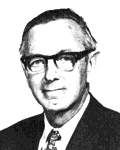
Maston Beard Maston Beard graduated in 1939 from Sydney University and was involved in radio transmitter design and radar research until joining the CSIRAC project in 1947. When the computer was moved to the University of Melbourne in 1955, he continued work on digital techniques and the application of computers in connection with navigational aids for civil aviation, the processing of data from radio telescopes, the control of Narrabri radio heliograph, and the control of the Siding Spring 3.9-meter telescope. He retired from CSIRO in 1978 while assistant chief at the Division of Computing Research. Following his retirement he served as a Senior Research Fellow in the CSIRO Division of Radiophysics. In 1980 he was awarded an Order of Australia Member (AM), in recognition of services to Radiophysics.
Trevor Pearcey
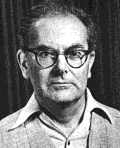
Trevor Pearcey Trevor Pearcey graduated in 1940 from Imperial College, London with First Class honours in Physics and Mathematics. He came to Australia in late 1945 to work at the Radiophysics Division of CSIR. After working on radar systems, he began his career in computing by initiating the CSIRAC project in 1947. This project was followed by studies of programming languages in the United Kingdom and of computer networks when he returned to Australia in 1959. After a period as a consultant with the Control Data Corporation on the STAR 100 project, he retired from the Caulfield Institute of Technology (now Monash University) in the late 1980’s.
Trevor Pearcey died on Tuesday, 27 January 1998.
-
In the eight years of operation (about 30,000 hours of 'uptime') at Melbourne University, over 700 computing projects were processed by CSIRAC. A brief list of these projects follows:
- Simulations of the practical operation of the Victorian power supply system by the SECV (State Electricity Commission of Victoria).
- Pattern simulations for the arrangement of atoms in face-centred cubic crystals (eg: tungsten and platinum).
- Evaluation of the growth rate of a stand of Pinus Radiata for the Forestry Commission of Victoria.
- Production of Solar Position and Radiation Tables for Australian capital cities for the CSIRO Division of Building Research.
- Calculation of the loan repayment schedule for University staff member’s housing loans.
- Computation of the radiation patterns of the rhombic antennae used by the Army Signals Branch at Donnybrook.
- Rigid-frame and grid-frame analysis for many of the 'high'-rise buildings (to around 25 stories) built in Australia in the early 1960s.
Earlier, whilst still located in Sydney, the CSIR Mk1 had been used for
- Analysis of flood data for the design of dams for assembling the Snowy Mountains Hydroelectric Authority (SMHA).
As you can see, the programming projects were many and varied. A large number of the major engineering projects in Australia during the 50s and 60s had a major input from CSIRAC.
Not bad for a machine that was originally intended
as a research computer, in order that investigation into programming techniques and electronic computer circuitry could be undertaken.
-
CSIRAC had two main storage systems. These could be described as the RAM and the Hard Disk in today’s terms.
The disk/drum
Brian Cooper, a third senior member of the design team, designed and built the magnetic “drum” storage system. The design work on it started in 1952, and a number of trials of different fast and slow designs were performed, including a drum-based device of 1024-word capacity (disk drives of the 1990’s with a capacity of 1000000 bytes are used in entry-level personal computers) and a mean access time of only 5-milliseconds (disk drives today can only just match that speed!).
By 1956, a horizontal-axis disk-type device was permanently installed with one segment of 1024 words in use. This store was a four-segment, 20-bit parallel system (it had no seek time, as it read all 20 bits in parallel; the access time was due to the rotational latency of the spinning disk), each segment being addressed by the 10-bit address of an instruction (there was no Disk Operating System, as the data was directly addressable). Each segment was given its appropriate source or destination code, and a 10-bit coincidence between this address and the disk clock track count was detected as the drum rotated and serial-parallel transformations and time inter-clocking performed.
Mercury delay lines
CSIRAC’s main memory design allowed for thirty-two acoustic mercury delay lines, each with the capacity to store 16 words (of twenty bits); this was later upgraded to 32 words when a method of interleaving was devised by Reginald Ryan. A total of 1024 words of storage was therefore possible but only a maximum of 768 were ever available!
Mercury delay line technology was developed for radar systems during World War II. These worked by storing data as a series of acoustic pulses in a tube of mercury.
Some of the CSIRAC mercury tubes were about 10mm in diameter and 150cm long. A modulated pulse was generated by a transducer at one end of the tube, and 960 microseconds later it arrived at the other end of the tube where it was received by another transducer. The modulated pulse was detected, amplified, re-shaped and re-generated, being fed back into the beginning of the tube.
The tubes were housed in a box affectionately referred to as the coffin. This was a wooden box about the size of a real coffin and contained a heater which kept the tubes at a constant temperature of about 40 degrees Celsius (about the hottest Melbourne summer’s day!).
All of the incidental registers were also mercury delay lines, however they were only about 6 inches long and were housed in another box above one of the control racks.
-
The console consisted of two main parts:
Input devices

The main console The switch-panel was the only method by which simple programs or program data could be manually entered or modified in the main store. This process was difficult, as all information was entered in binary, using the rows of switches. Other functions available were disk write control and the speed control (Yes, even CSIRAC had a “Turbo” switch!).
Output devices

12-hole paper tape reader The CRT displays allowed the user to monitor the state of the machine. The A, B, C and H registers were available and could be constantly monitored during debugging . Any bank of sixteen words of the main store could be viewed in binary as well as the index registers. As a result, users had a primitive (16 x 20) bit mapped display on which cartoon characters were often displayed!
The console also had a modified ex-PMG Teletype for printing, and an old Rola speaker for reproduction of “music". The speaker’s main purpose was for debugging. It was connected to the machine as an I/O device and instructions would be placed in the main program to produce “clicks” from the speaker. The operator would then know if the program had reached that part of the code successfully.
Programmers soon realised that CSIRAC could be instructed to play music, and experiments were soon implemented. These program tapes still survive and show that CSIRAC was probably the first computer to “play" music in the early 1950s.
CSIRAC vs today's computers
When you look at the chart below, you might think that CSIRAC was a pretty slow machine, but you must compare it to what was available to the scientists of the time.
Scientists of the 1940’s would employ one or more computers (generally a person operating a mechanical adding machine), or manually perform complex computations by hand, to complete their research. Calculations could be performed at about the rate of one operation per second.
CSIRAC, although slow by today’s standards, was faster than anything else available at the time at 1000 operations per second.
| CSIRAC - 1956 | Desktop PC - 1996 | Laptop - 2000 | Smart phone - 2014 | |
|---|---|---|---|---|
| Speed | .001MHz | 100MHz | ||
| Word size | 20 bit | 32 bit | 32 bit | 64 bit |
| RAM | 768 words (1,920 bytes) | 8,388,608 bytes | 536,870,912 bytes | 1,073,741,824 bytes |
| Disk capacity | 2048 words(5,120 bytes) | 1,048,576,000 bytes | 19,327,352,832 bytes | 137,438,953,472 bytes |
| Power consumption | 30,000 watts | 250 watts | 50 watts | 3 watts |
| Weight | 2,000kg | 2kg | 2.6kg | 129g |
Today the University of Melbourne's Research Computing Services oversees:
- More than 9000 cores of high-performance central processing unit (CPU) computing platform
- More than 300 nodes of general purpose graphics processing unit (GPGPU) computing platform
- More than 25,000 virtual cores of cloud computing platform including virtual desktop and virtual server configurations
- More than four petabytes of computational storage
- More than 20 petabytes of research data storage
- Access to over 700 software applications
- Access to 10,000,000 service units at the National Computational Infrastructure supercomputing facility
- Access to more than 5000 virtual cores of cloud computing in the Melbourne Node of the Nectar Research Cloud.
CSIRAC: A Timeline
- 1945
-
Trevor Pearcey sees Howard Aiken’s Mk1 (or Automatic Sequence Controlled Calculator) at Harvard, and decides that paper tape-based systems are too slow, and that a fully electronic design would be superior.
- 1946
-
Trevor Pearcey begins to formulate the logical planning for an “Automatic Computer” .
- 1946
-
Chief of Radiophysics Edward Bowen and Assistant Chief Joseph Pawsey decided on radioastronomy and rain-physics as the two main areas of research, with a third, radio propagation dropped in favour of the development of electronic computing.
- 1948
-
Construction of the Mk1 computer begins with Maston Beard in charge of engineering and Trevor Pearcey covering the logical design.
- 1949
-
First test program is run in late November — a long multiplication routine.
- 1951
-
Brian Cooper constructs a drum-based secondary storage unit, and begins to construct a larger drum-based device with greater capacity.
The Mk1 is publicly demonstrated.
Music first played on the Mk1.
- 1953
-
Reginald Ryan doubles the Mk1’s mercury delay line storage capacity to 1024 words.
- 1954
-
Maston Beard with the assistance of Geoff Chandler completely redesigns the main memory circuits which were designated MKII.
- 1955
-
Maston Beard designs a disk-type secondary storage unit, abandoning Brian Cooper’s second drum-type design.
The Mk1 is dismantled for shipment to Melbourne.
- 14 June 1956
-
The Computation Laboratory is opened at the University of Melbourne and the machine is renamed “CSIRAC” .
- 1964
-
CSIRAC is decommissioned and donated to the Museum of Victoria. It is replaced by an IBM 7044.
- 1980s
-
CSIRAC is removed from storage and placed on display at Caulfield (later Chisolm) Institute of Technology (now Caulfield campus, Monash University).
- 1992
-
CSIRAC is returned to storage in the Museum of Victoria.
- 1996
-
In June the machine is placed on display at the University of Melbourne, as part of the 40th Anniversary Celebration of CSIRAC arriving in Melbourne.
- 1996
-
In December, CSIRAC is placed back into storage at the Scienceworks Museum in Spotswood.
- 2000
-
Publication of:
- 2001
-
CSIRAC is placed on display at Museum Victoria, Carlton Gardens, Melbourne.
- 2018
-
CSIRAC is on permanent display at Scienceworks Museum, Spotswood
-

An end view of the mercury delay line temperature controlled cabinet known as “the coffin"
An end view of the mercury delay line temperature controlled cabinet known as “the coffin". Circa 1956. -

Jurij Semkiw at CSIRAC operating console
Jurij Semkiw at CSIRAC operating console, 1964. FEIT-CIS Heritage Collection. -
CSIRAC console switch panel
A closeup of the CSIRAC console switch panel. Note the multiple rows of 20 switches used to set bits in various registers, c1956. MSE-CIS Heritage Collection. -
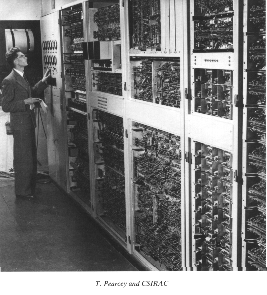
Trevor Pearcey in front of CSIR Mk1 in Sydney
Trevor Pearcey, in front of CSIR Mk1 in Sydney, 1952. Image courtesty CSIRO. FEIT-CIS Heritage Collection. -
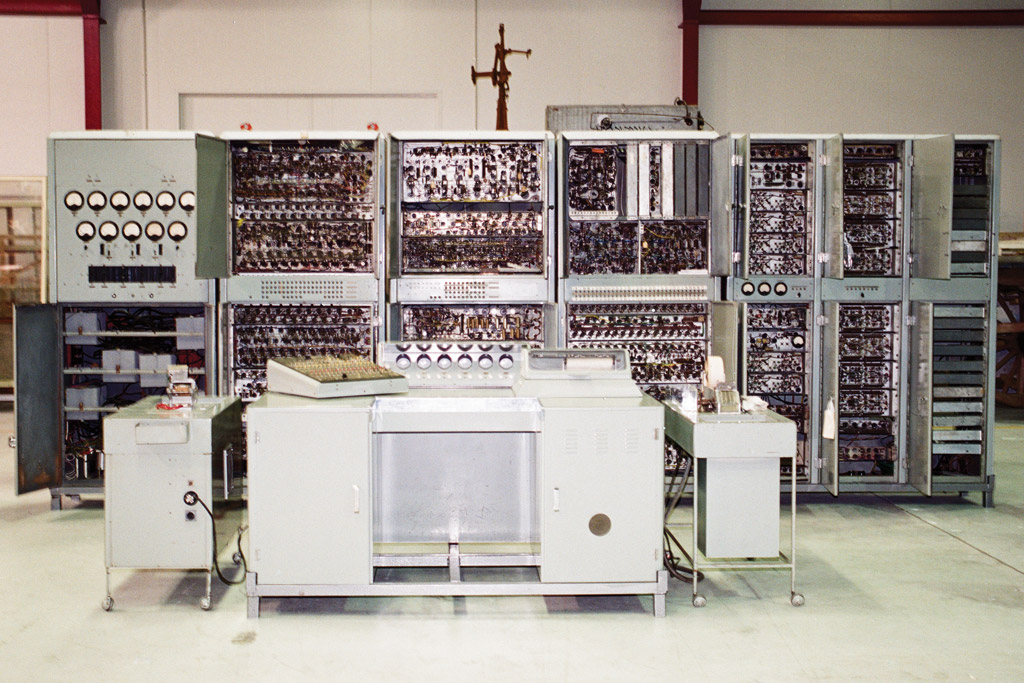
CSIRAC at Museums Victoria
CSIRAC with cabinet doors open, as displayed at the Museum of Victoria for its 50th birthday celebration in 1999. Image courtesy Paul Doornbusch. -
12-hole paper tape reader
12-hole paper tape reader used for loading programs (and data) into CSIRAC’s memory, c1956. FEIT-CIS Heritage Collection. -
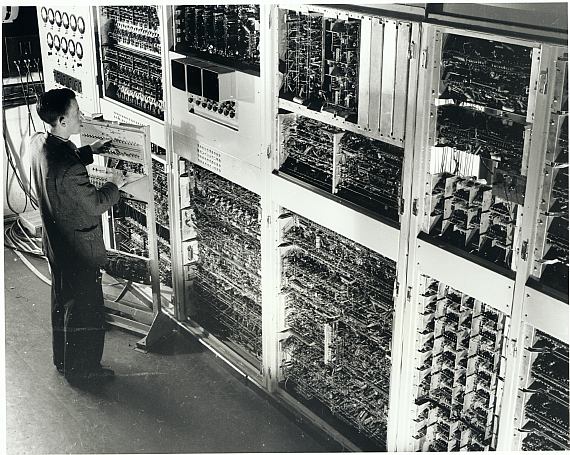
CSIR Mk1 with doors off
CSIR Mk1, doors off, in the Radiophysics Laboratory, Sydney. Geoff Hill, June 1952. -

CSIRAC on the move (colour)
CSIRAC on the move on a semi-trailer at the northern outskirts of Benalla, Victoria on the Hume Highway. Maston Beard standing in the centre of the photo with the driver and his assistant, June 1955. FEIT-CIS Heritage Collection. -
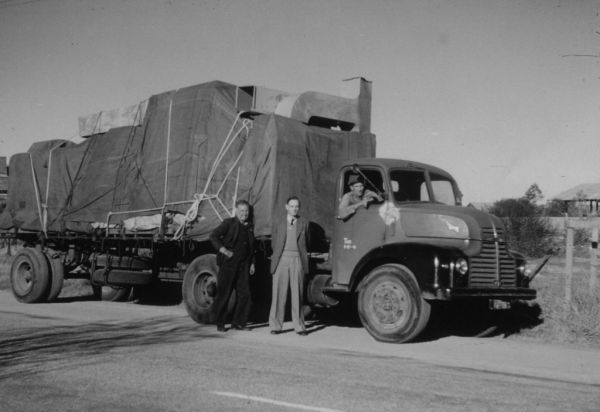
CSIRAC on the move (B&W)
CSIRAC on the move on a semi-trailer at the northern outskirts of Benalla, Victoria on the Hume Highway. Maston Beard standing in the centre of the photo with the driver and his assistant, June 1955. FEIT-CIS Heritage Collection. -

CSIRAC magnetic disc ‘drum’
CSIRAC magnetic disc ‘drum’, 1956. FEIT-CIS Heritage Collection. -
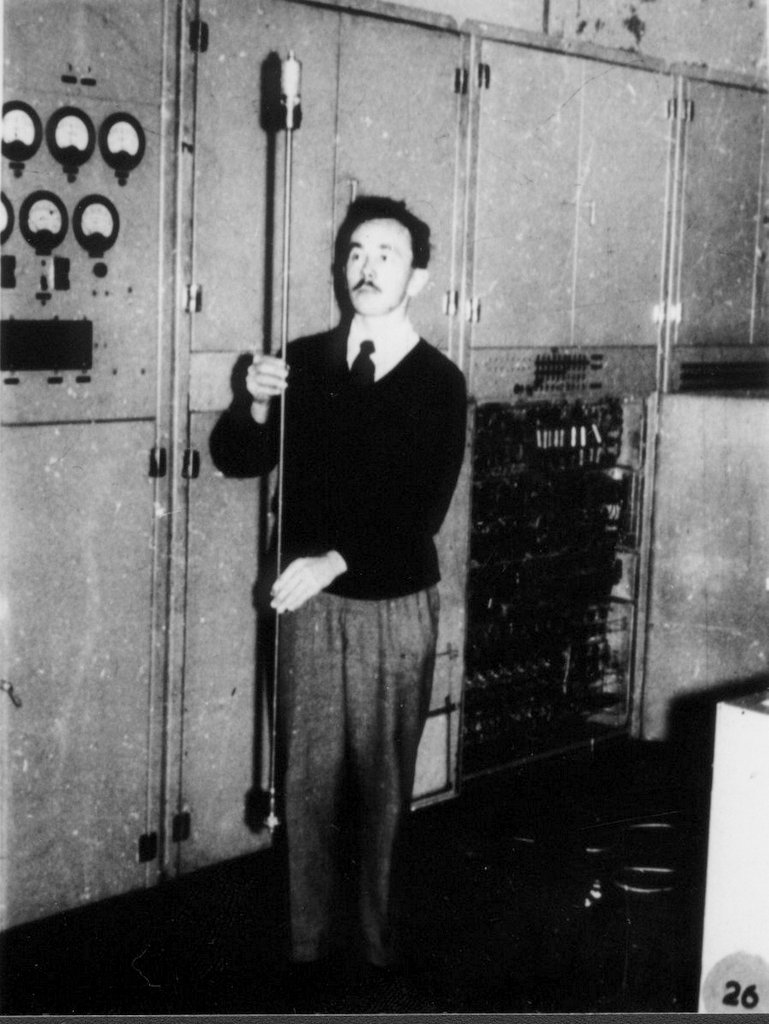
Jurij Semkiw displaying a mercury delay line
Technical staff member Jurij Semkiw displaying a mercury delay line, 1956. FEIT-CIS Heritage Collection. -
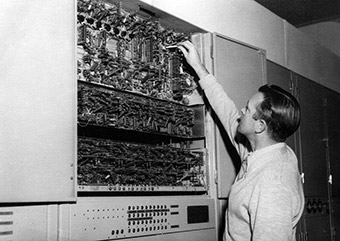
Adjusting main clock frequency of CSIRAC
Ron Bowles adjusting main clock frequency of CSIRAC at University of Melbourne, 1956. FEIT-CIS Heritage Collection. -
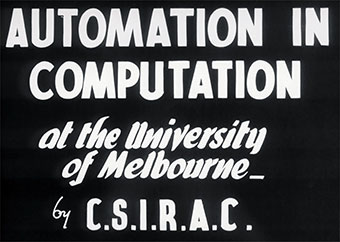
CSIRAC sign
Sign: Automation in Computing at the University of Melbourne by CSIRAC

Acknowledgements
The CSIRAC pages were originally authored by Steven Pass, then substantially revised and maintained by David Hornsby. Further extracts are taken from:
The Last of the First, CSIRAC: Australia’s First Computer
By Doug McCann and Peter Thorne, pgt@unimelb.edu.au, ISBN 0 7 7340 2024 4. Used with kind permission.