Working in computing at the University
Recollections of working include the pleasure of mentoring talented students and developing close working relationships with colleagues, the freedom to implement creative approaches to teaching and research, and the excitement of working on ground-breaking projects.
A common challenge was adapting to rapid change, as the Department or School constantly evolved.
The days working with CSIRAC were exciting, we had a sense of being at the beginning of something new which had a long way to go. There were virtually no demarcations based on rank, and every day was an adventure.
Kay Thorne
This is a department that has evolved to be more international in focus without forgetting its people, or without forgetting its traditions such as its love of the C language.
Tony Wirth
In 1999–2001 I was teaching brilliant undergraduate students many of whom I still see today both in Australia and overseas. Research has become first rate.
Brian Corbett
Joining the department meant that I could work with leading researchers, who were names that I read on publications, working in the department I got to know them.
Rachelle Bosua
I’ve worked with a lot of remarkable people. As a staff member I finally found a job that I (usually) like. Very few jobs are like this.
Greg Wadley
Not long after student fees were introduced we changed faculty, there was a complicated process we had to go through to alter the point values of our courses. I wrote a satirical play that a group of us performed.
Lee Naish
Excerpt from play:
Welcome to meeting 57 of the Points, Weights and Measures 2000 planning committee … Now, the minutes of the last meeting … did we take minutes? We took hours.
Uniprocessors
The Uniprocessors were Department staff members who used juggling, unicycling and fire breathing to teach computing concepts in a playful way, and to attract students to the Computer Science course, during the late 1980s and early to mid 1990s.
The Uniprocessors started off as a bit of a joke. There used to be a lunchtime BBQ and honours student Review on the last Friday of the year, one year I had a lecture on algorithms and data structure at 3.15pm and it seemed a little inappropriate to have a serious lecture after that. A few of us in the Department did busking, so we demonstrated concepts with juggling.
Lee Naish
An excerpt from the lecture notes:
Why is juggling so popular amongst computer scientists? They are trying to solve the biggest open problem in theoretical comp sci — Does P = NP. If anyone can find a way to learn how to juggle N balls in polynomial time then the problem is solved. So if you see a computer science lecturer juggling — don’t disturb them — they are engaged in important research.
Lecture notes c.1997, Lee Naish
I busked in order to pay my way through University. What was surprising was how many computer scientists were (and are) jugglers. I suspect it’s tied to the recent discovery that juggling is one of the best things for neuroplasticity.
Peter Stuckey
I had seen the mountaineering club abseil down the Redmond Barry Building, sometimes in a silly way, like on roller skates, or naked. I brought along my unicycle and some extra climbing gear and convinced them to let me abseil on my unicycle. It didn’t really work very well, just long enough to get to the photo!
Lee Naish
-

Staff of Computation Lab, c1960
Staff of Computation Lab, c1960. Trevor Pearcey, Ron Bowles, Kay Sullivan (Thorne), Jurij Semkiw, Geoff Hill, Frank Hirst at the University of Melbourne. FEIT-CIS Heritage Collection. -
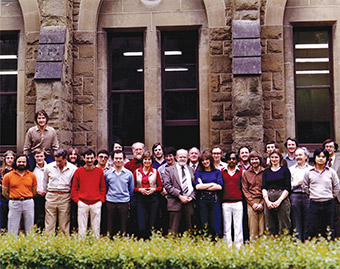
Department staff photo, 1984.
Department staff photo, 1984. University of Melbourne. -
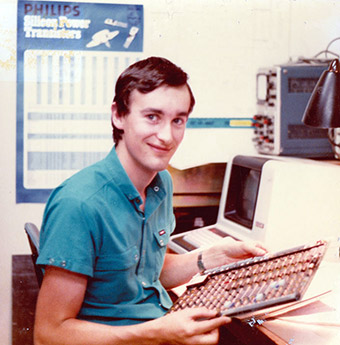
Steven Lynch, Department technical staff, 1987.
Steven Lynch, Department technical staff, 1987. University of Melbourne. -
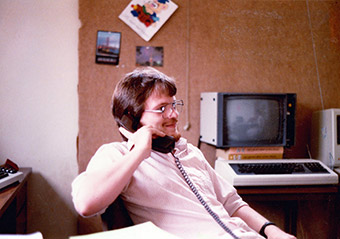
Justin Zobel, Senior Tutor, 1987
Justin Zobel, Senior Tutor, 1987. Image courtesy University of Melbourne. -
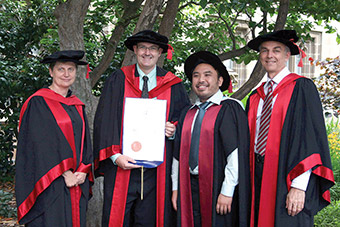
Sean Maynard Graduation, 2010.
Sean Maynard Graduation, 2010. University of Melbourne. -
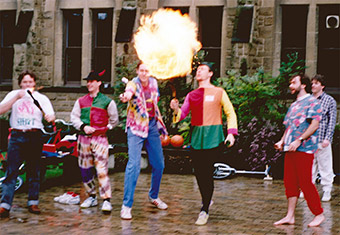
The Uniprocessors at Discovery Day, 1994
Discovery Day, 1994. The Uniprocessors recruiting students to the department. Photo by Michael Silver. -
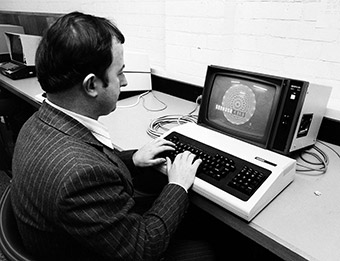
Staff Digital Gigi terminal, c1982.
Staff member at Digital Gigi terminal, c1982. Image courtesy University of Melbourne Archives. -
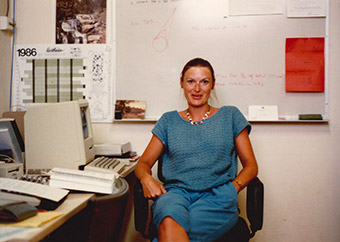
Prue Downey, 1986
Prue Downey, Staff Member and Student, 1986. Image courtesy University of Melbourne. -
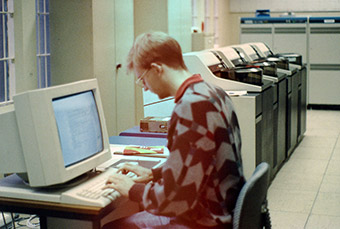
Programming using the Sun 3/60, 1987
Andrew Mack, Systems Programmer using the Sun 3/60. VAX 11/780 in background, c1987. Image courtesy University of Melbourne. -
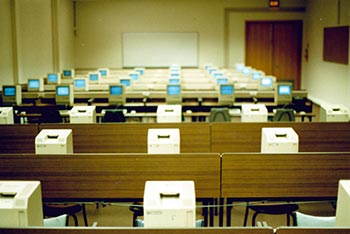
Computer Science lab 1987
Computer Science lab, Richard Berry building, c1987. University of Melbourne. -
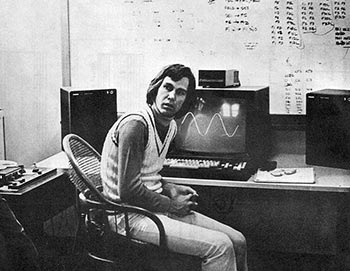
Barry Conyngham, Computer Music Studio, Computer Science Department c1970s.
Barry Conyngham, Computer Music Studio, Computer Science Department c1970s. Image courtesy Barry Conyngham. -
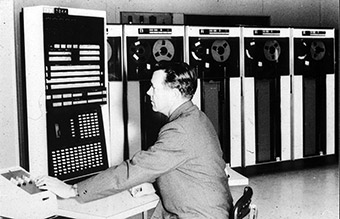
Ron Bowles at the IBM 7044, c1969
Ron Bowles at the IBM 7044, c1969. Image courtesy University of Melbourne Archives. -
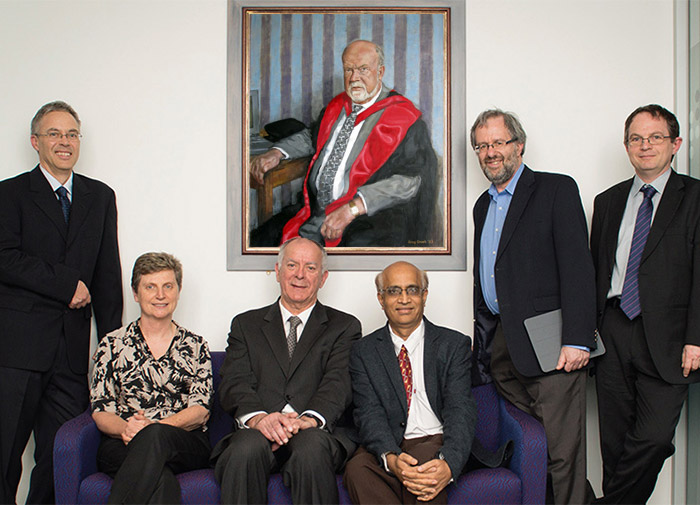
Former Heads of Department, 2013.
Former and Current Heads of Department, 2013. Left–right: Professor Alistair Moffat, Professor Liz Sonenberg, Dr Peter Thorne, Professor Rao Kotagiri, Professor Leon Sterling, Professor Justin Zobel (with portrait of Professor Peter Poole). Image courtesy University of Melbourne. -
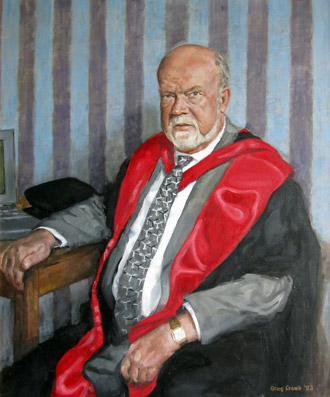
Portrait of Peter Poole
Portrait of Peter Poole -
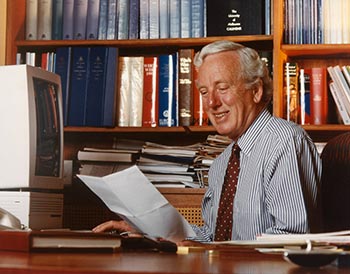
Professor David Pennington Vice Chancellor with computer, c1990
VC David Pennington with computer, c1990.
Studying computing at the University
Being a student has changed over time, but the excitement of being part of the computing revolution is new for every generation of students.
Many of the students from the Department and School have gone on to influential roles in academia and industry.
As a young student I unexpectedly found myself associated with a group of people who were operating one of the largest electronic machines in the country. The laboratory was a very interesting place … where we all helped each other.
Peter Thorne, about the late 1950s
In 1969 computing was very novel. The courses were oriented to numerical analysis. The differences between the late 60s (5 academic staff, one mainframe computer) and the current time are massive. One lecturer actually wore a gown when lecturing, although it was rare even then.
Jim Breen
I remember the enthusiasm of the staff and the feeling that we were all part of something new and exciting.
Cathie Jilovsky, about her time as a student in 1970–71
I was a first year student in 1975. (The course) introduced me to computing, which has fascinated me ever since. The access to hands-on hardware was very new.
Graham Menhennit
In the 1980’s in order to the cope with the increasing number of students from the department, and across the university, who were undertaking introductory programming courses, the university installed a number of mini-computer based MONECS (Monash Educational Computer System) systems. Students entered their programs by using a paperclip to push out chads on pre-punched cards or marked cards with a pencil.
Peter Thorne
The best thing I got from my studies was the career which ensued as a result — and I have to say I enjoyed the earlier days when we were forging the new frontiers.
Peter Garriga
My first summer in the department, in 1995/6 was memorable — a tight-knit group of quirky, dedicated scientists, supportive of undergraduates. Lots of ‘culture’ around UNIX, functional and logic programming. I’m still friends and colleagues with many of the people I got to know that summer. For years, it defined the music I listened to, and the topics I spoke about. I’m still fond of that time, but I’m also glad to have grown up since then!
Tony Wirth
I am very confident that the early Information Systems students will go on to be among the leaders of the IS profession in Australia in the future. We will see them.
Mike Vitale
-
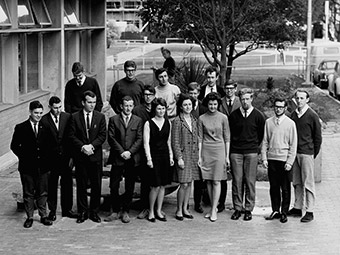
Theory of Computation Students, circa 1965
Theory of Computation Students, circa 1965, University of Melbourne. FEIT-CIS Heritage Collection. -
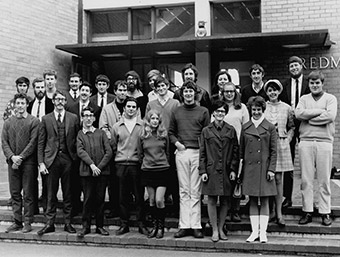
Theory of Computation II Students, 1969
Theory of Computation II Students, 1969. FEIT-CIS Heritage Collection -
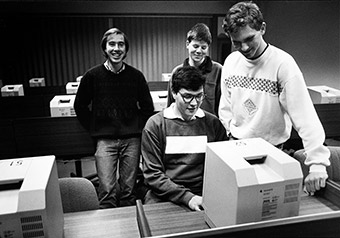
Computer Science laboratory 1989
Computer Science laboratory with Andrew Conway, Ivan Hamilton, Barry Brannan and John Henrikson, c1989. Image courtesy University of Melbourne Archives. -
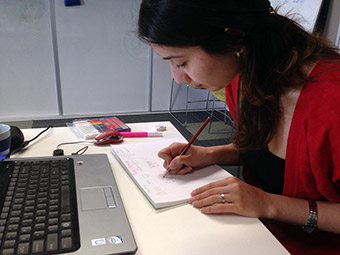
Behnaz Rostami at OzCHI
Behnaz Rostami was a part of the Department student team that won second prize in the OzCHI conference 24 hour design challenge, for their project re-imagining email. Photo by Sarah Webber. -
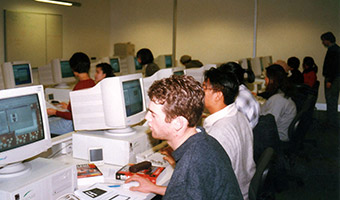
DIS Computer Lab, c1997
DIS Computer Lab, c1997. University of Melbourne. -
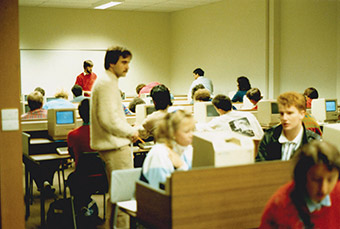
Computer lab with Macs, 1989
Computer lab with Macs, c1989. University of Melbourne. -
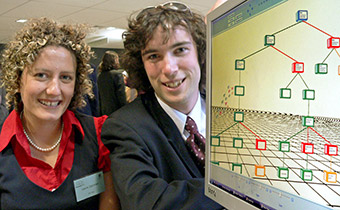
Students at ICT Panorama 2006
Computer Science and Software Engineering students Laura Zalcman and David Kent with their team’s Rational Argument Mapping and Visualisation software at ICT Panorama 2006. Image courtesy Paul Richiardi.